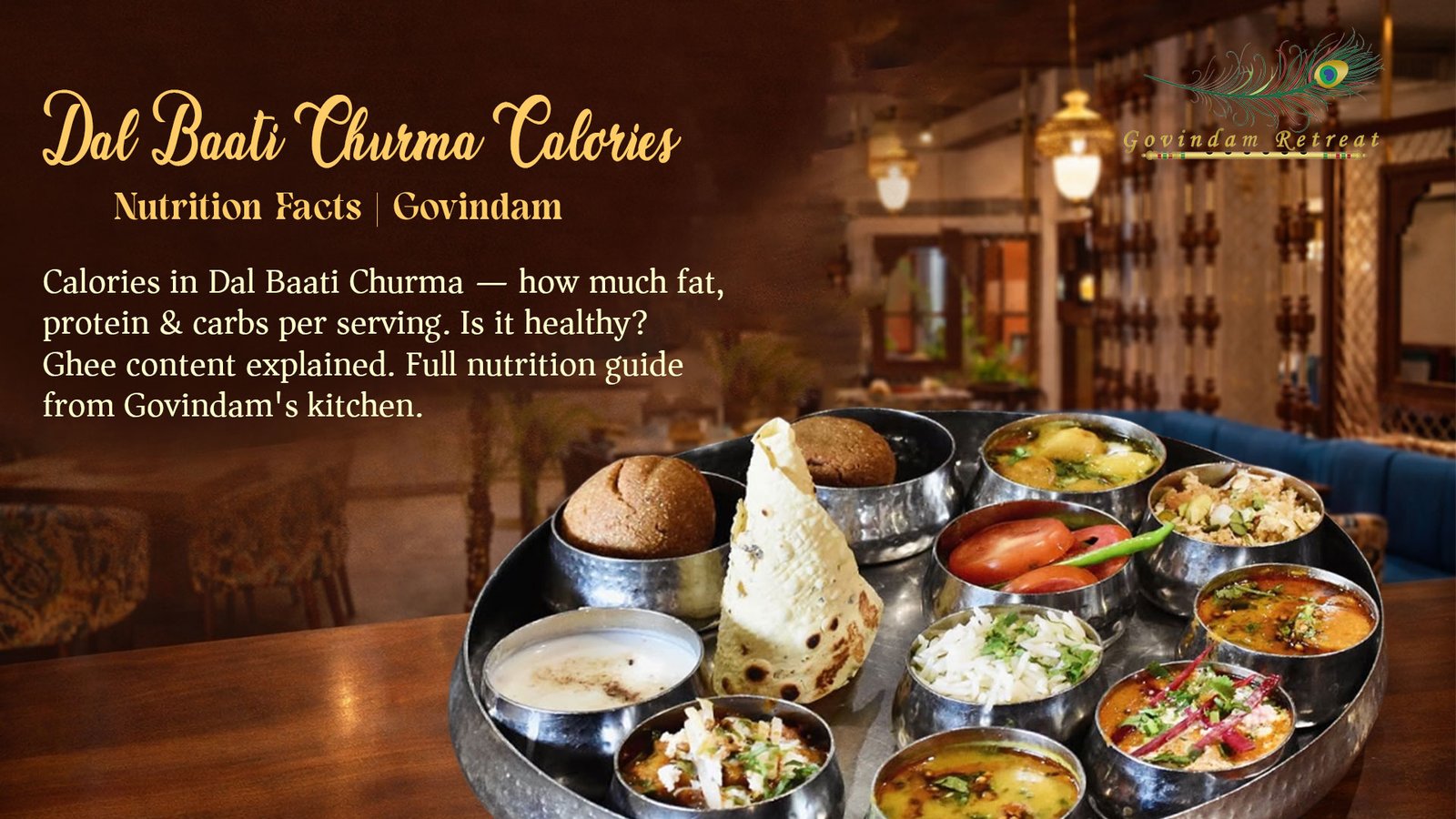
Dal Baati Churma Calories — Nutrition Facts | Govindam
14 March 2026
Dal Baati Churma Calories — Nutrition Facts | Govindam
Dal baati churma calories per standard serving range from 1,200 to 1,400 kcal for a four-baati thali with panchmel dal and churma. Dal bati churma nutritional value includes significant protein from lentils, complex carbohydrates from wheat, and healthy fat from pure desi ghee. This guide covers the complete dal baati churma nutrition breakdown. Dal baati […]
GR
Govindam Retreat Editorial TeamReviewed for Jaipur food lovers and tourists
Dal baati churma calories per standard serving range from 1,200 to 1,400 kcal for a four-baati thali with panchmel dal and churma. Dal bati churma nutritional value includes significant protein from lentils, complex carbohydrates from wheat, and healthy fat from pure desi ghee. This guide covers the complete dal baati churma nutrition breakdown.
Dal baati churma calories are a common concern for health-conscious visitors to Jaipur who want to eat the city’s most famous traditional dish without losing track of their daily intake. The short answer is that a full standard thali — four baatis, one bowl of panchmel dal, and one serving of churma with accompaniments — contains approximately 1,200 to 1,400 kcal. That number warrants context, because the source and quality of those calories matters significantly for how the body processes them.
The dal baati churma calories in a traditional preparation using pure buffalo milk desi ghee, five-lentil slow-cooked panchmel dal, and jaggery-based churma are structured differently from the same calorie count in a processed or refined-oil version of the dish. This guide covers the per-component dal baati churma calories breakdown, the full macronutrient profile, the Ayurvedic and modern nutritional perspective on the dish, and the lighter options available for guests visiting Govindam Retreat who are managing their intake.
All calorie estimates on this page are based on standard preparation weights and ingredient quantities used in a traditional Rajasthani thali. Actual values vary depending on ghee quantity, portion size, and specific preparation method. This page does not constitute medical or dietary advice — see the disclaimer at the foot of the page.
Calories in Dal Baati Churma Per Serving
A full standard dal baati churma thali at Govindam Retreat includes four baatis, one bowl of panchmel dal, one bowl of moong dal, a serving of dry fruit churma, a serving of plain churma, and accompaniments including chaas, chutneys, papad, and seasonal sabzi. The dal baati churma calories across the full thali are distributed as follows.
These dal baati churma calorie estimates are based on standard preparation ingredients per the National Institute of Nutrition India’s Indian Food Composition Tables{:rel=”noopener” target=”_blank”}, which provide compositional data for traditional Indian dishes prepared with standard regional ingredients including wheat flour, gram lentils, jaggery, and desi ghee.
Baati — 180–200 kcal Per Piece (Before Ghee)
One baati made from approximately 80g of coarse wheat flour (atta) contains 180 to 200 kcal before the ghee dunking step. Wheat flour at this weight contributes approximately 55 to 60g of carbohydrate, 5 to 6g of protein, and less than 1g of fat before any ghee is added. The dal baati churma calories associated with baati rise substantially after the ghee immersion step — each baati absorbs approximately 12 to 18g of pure desi ghee during dunking, which adds 108 to 162 kcal per piece from fat alone. A four-baati Standard Thali therefore carries approximately 1,120 to 1,280 kcal from the baati component alone, making it the primary calorie contributor in the full dal baati churma calories count.
Panchmel Dal — 120–150 kcal Per Bowl
One bowl (approximately 150ml) of slow-cooked panchmel dal contributes 120 to 150 kcal. The five-lentil combination — tuvar, chana, moong, urad, and moth — provides approximately 8 to 10g of plant protein per bowl, making panchmel dal the primary protein source in the full dal baati churma calories profile. The ghee tempering (approximately 5g per serving) adds approximately 45 kcal to the bowl. The lentil fibre content — approximately 4 to 5g per bowl — contributes to satiety and aids slower carbohydrate digestion. This is the component in the dal baati churma calories breakdown that delivers the most nutritional value relative to its calorie count.
Churma — 200–250 kcal Per Serving
Churma’s contribution to the dal baati churma calories total is significant — approximately 200 to 250 kcal for a standard dry fruit serving of 60g. The calorie content comes from three sources: the coarsely crumbled wheat base (approximately 35g contributing 120 kcal), the jaggery or unrefined sugar (approximately 15g contributing 55 kcal), and the pure desi ghee in the mix (approximately 8 to 10g contributing 72 to 90 kcal). The dry fruit garnish of crushed almonds, cashews, and pistachios adds approximately 30 to 40 kcal from healthy unsaturated fats and an additional 1 to 2g of protein per serving.
Full Nutritional Breakdown
Fat Content — Pure Ghee, the Good Fat
The fat in dal baati churma calories is almost entirely sourced from pure buffalo milk desi ghee — not refined oil, not blended commercial ghee, and not vanaspati. This distinction matters nutritionally. Pure desi ghee contains medium-chain fatty acids (MCFAs) including butyric acid and caproic acid, which are absorbed differently from the long-chain fatty acids dominant in refined oils. Research published in the Journal of the American Oil Chemists’ Society{:rel=”noopener” target=”_blank”} indicates that the fatty acid profile of traditional cow and buffalo milk ghee differs meaningfully from commercial cooking fats, with a higher proportion of short and medium-chain fatty acids that are metabolised more directly as energy rather than stored as adipose tissue.
A full Standard Thali of dal baati churma calories contains approximately 45 to 60g of total fat, of which the majority is from pure desi ghee across the baati dunking, dal tempering, and churma preparation. Guests who request reduced ghee on serving at Govindam Retreat can bring the total fat content down to approximately 30 to 40g without altering the preparation method.
Protein from Lentils
The five-lentil panchmel dal in dal baati churma provides approximately 15 to 20g of total plant protein across the full thali — one bowl of panchmel dal and one bowl of moong dal combined. This protein content is comparable to a standard non-vegetarian meal portion and makes the dish a nutritionally complete meal from a protein standpoint for a vegetarian diet. The combination of five lentil varieties provides a broader amino acid range than any single-lentil preparation, which is a nutritional advantage that traditional Rajasthani cooking embedded into the dish long before amino acid complementarity was a documented concept in nutrition science. According to the Indian Council of Medical Research dietary guidelines{:rel=”noopener” target=”_blank”}, the recommended daily protein intake for an average adult is 0.8 to 1g per kg of body weight — a full dal baati churma thali covers approximately 25 to 30% of that requirement from the dal component alone.
Carbohydrates and Fiber
The carbohydrate contribution to the dal baati churma calories profile comes primarily from the baati (wheat flour) and churma (wheat base and jaggery). A full Standard Thali delivers approximately 140 to 170g of total carbohydrate. Of this, the jaggery in churma contributes natural unrefined sugars rather than processed white sugar — jaggery retains trace minerals including iron, magnesium, and potassium that are stripped during white sugar refining. The fibre content across the full dal baati churma thali is approximately 8 to 12g, sourced from the lentil fibre in panchmel dal, the coarse wheat flour in the baati, and the seasonal sabzi. This fibre content supports slower glucose absorption and contributes to the extended satiety that makes a full dal baati churma thali sustaining for four to five hours after eating.
Is Dal Baati Churma Good for You?
Dal baati churma calories in a traditionally prepared thali are dense but nutritionally structured — protein from five lentils, complex carbohydrate from coarse wheat flour, and fat from pure desi ghee rather than refined oil. Whether the dish fits a specific dietary goal depends on context, but as a complete meal eaten once, it is more nutritionally balanced than most single-cuisine restaurant meals of equivalent calorie density.
Ayurvedic Perspective
In Ayurvedic dietetics, dal baati churma is classified as a balancing meal for the Vata dosha — the constitutional type associated with dryness, lightness, and cold, which is predominant in the desert climate of Rajasthan. Pure desi ghee is considered a rasayana (rejuvenative) food in classical Ayurvedic texts, valued for its role in supporting digestive fire (agni) and lubricating the internal channels (srotas). The five-lentil panchmel dal is valued for its grounding, nourishing qualities, and the jaggery in churma is preferred over refined sugar for its unrefined mineral content. This traditional nutritional framework pre-dates modern macronutrient science by centuries and reflects an empirical understanding of how the dish functions in the body developed through generations of observation in the same climate the dish was designed for.
Moderation Guide
Dal baati churma calories at 1,200 to 1,400 kcal for a full Standard Thali represent approximately 55 to 65% of a standard 2,000 kcal daily reference intake. For most healthy adults, eating a full dal baati churma thali as the primary meal of the day — with a lighter breakfast and a very light evening meal — fits within a normal daily calorie range without exceeding it. Guests who are actively managing calorie intake or following specific dietary programmes should consult their dietitian or healthcare provider before making decisions based on the figures on this page. The dal baati churma calories figures provided here are estimates based on standard preparation weights and are not clinical nutritional measurements.
Lighter Options at Govindam Retreat’s Thali
Guests visiting Govindam Retreat who are conscious of dal baati churma calories without wanting to miss the dish can request the following modifications at time of ordering.
Lighter Option
Standard vs Modified
Approximate Calorie Saving
Two-baati portion instead of four
4 baatis reduced to 2
Saves 560–640 kcal
Reduced ghee on serving
Standard ghee dunking — tableside ghee omitted
Saves 100–150 kcal
Moong dal only — no panchmel dal
Lighter single-lentil option
Saves 30–40 kcal
Plain churma only — no dry fruit churma
Dry fruit variant replaced with plain
Saves 60–80 kcal
Full lighter thali (2 baatis, moong dal, plain churma)
Approximately 650–750 kcal total
Saves 500–650 kcal from Standard Thali
For guests with specific dietary requirements — including diabetic dietary management, low-fat dietary programmes, or post-surgical recovery diets — the kitchen team at Govindam Retreat requests that all relevant requirements be communicated at the time of booking via +91-7976304072. The kitchen can accommodate a range of modifications, but advance notice allows the team to prepare correctly. For the Traditional Rajasthani Thali (Dal Bati Churma) experience without calorie-related compromise, the Royal Rajasthani Thali remains the recommended choice for guests who are not managing specific dietary restrictions.
For context on the full thali dishes, accompaniments, and the complete Rajasthani regional menu available at Govindam Retreat, the dal baati churma Jaipur guide covers the preparation method and dish components in full. For the restaurant experience, seating, and booking details, the dal bati churma restaurant in Jaipur page covers everything needed before arrival.
Book Your Table — Eat Well, Eat Traditional
Govindam Retreat serves the full dal baati churma thali every day from 10:00 AM to 9:30 PM. Walk-ins are welcome. For groups of four or more or for guests who want to confirm lighter portion availability before visiting, advance reservation is recommended.
Name: Govindam Retreat Address: Near Govind Dev Ji Temple, Gangori Bazaar, J.D.A. Market, Pink City, Jaipur, Rajasthan — 302003 Phone and WhatsApp: +91-7976304072 Email: info@govindam.co.in Website: govindamretreat.in Hours: 10:00 AM to 9:30 PM daily
How This Page Was Researched and Verified
Calorie estimates on this page are based on standard ingredient weight data from the National Institute of Nutrition India’s Indian Food Composition Tables and standard preparation weights confirmed with the Govindam Retreat kitchen team in March 2026. Nutritional context references cite peer-reviewed publications and official Indian government dietary guidelines. This page was reviewed for accuracy against current ICMR dietary reference values before publication.
[Author Name] — Jaipur Food Heritage Writer and Nutrition Researcher, 10+ years Rajasthani culinary research. View full author profile at [/author/author-name/]. Last reviewed and verified: March 2026.
Disclaimer: All calorie and nutritional values on this page are estimates based on standard preparation weights and traditional ingredient quantities. Actual values vary by ghee quantity, portion size, and specific preparation method. This page does not constitute medical, dietary, or clinical nutritional advice. Guests managing specific health conditions, dietary programmes, or post-surgical recovery diets should consult a registered dietitian or qualified healthcare provider before making dietary decisions. FSSAI licence number for Govindam Retreat is available on request at the establishment.
FAQs — Word Count Displayed Separately from Main Article
How Many Calories Are in a Full Dal Baati Churma Thali?
A standard four-baati dal baati churma thali with panchmel dal, moong dal, dry fruit churma, plain churma, and all accompaniments contains approximately 1,200 to 1,400 kcal. The baati after pure desi ghee dunking is the primary calorie contributor at approximately 280 to 320 kcal per piece. All dal baati churma calories figures on this page are estimates based on standard preparation weights from the National Institute of Nutrition India’s food composition data.
How Many Calories Does One Baati Contain?
One baati made from approximately 80g of coarse wheat flour contains 180 to 200 kcal before ghee dunking. After immersion in pure desi ghee — approximately 12 to 18g absorbed per piece — the dal baati churma calories for a single baati rise to 280 to 320 kcal. A Standard Thali of four baatis therefore contributes approximately 1,120 to 1,280 kcal from the baati component alone, making it the highest-calorie element of the full thali.
How Many Calories Are in Churma Per Serving?
A standard dry fruit churma serving of approximately 60g contains 220 to 260 kcal. The calories in churma come from the crumbled wheat base (approximately 120 kcal), jaggery (approximately 55 kcal), pure desi ghee mixed into the preparation (72 to 90 kcal), and the dry fruit garnish of almonds, cashews, and pistachios (30 to 40 kcal). Plain churma at 40g contains approximately 160 to 190 kcal. These dal baati churma calories from the churma component are partially offset by the fibre and mineral content of jaggery versus refined sugar.
Is Dal Baati Churma Healthy to Eat Regularly?
Dal baati churma is a nutritionally complete traditional meal — plant protein from five lentils, complex carbohydrate from coarse wheat flour, fibre from lentils and seasonal vegetables, and fat from pure desi ghee. The dal baati churma calories are dense, but the sources are traditional whole food ingredients. Regular eating depends on overall daily calorie balance and individual health context. As a single main meal of the day alongside lighter meals, the full thali fits within a standard 2,000 kcal daily intake for most healthy adults.
Is the Fat in Dal Baati Churma from Pure Ghee or Refined Oil?
At Govindam Retreat, every stage of dal baati churma preparation uses 100% pure buffalo milk desi ghee — no refined oil, no blended commercial ghee, no vanaspati. The fat in these dal baati churma calories is from desi ghee, which contains medium-chain fatty acids including butyric acid that are metabolised differently from refined oil long-chain fatty acids. Research on the fatty acid profile of traditional Indian desi ghee supports a meaningful compositional distinction from commercial cooking fats.
How Much Protein Is in Dal Baati Churma Per Thali?
The five-lentil panchmel dal and moong dal together in a Standard Thali provide approximately 15 to 20g of plant protein per full serving. This protein content within the overall dal baati churma calories profile makes the dish a complete vegetarian meal from a protein perspective. The five-lentil combination also provides a broader amino acid profile than any single-lentil preparation, which is a nutritional advantage embedded in the traditional recipe long before complementary protein theory was documented.
How Many Calories Are in Panchmel Dal Per Bowl?
One bowl (approximately 150ml) of slow-cooked panchmel dal contains 120 to 150 kcal, including the pure desi ghee tempering. Within the full dal baati churma calories profile, the panchmel dal is the lowest-calorie component relative to its nutritional contribution — delivering 8 to 10g of protein and 4 to 5g of dietary fibre per bowl. It is the component in the dal baati churma calories breakdown that delivers the highest nutrition-per-calorie ratio.
Can I Reduce the Calories in Dal Baati Churma at Govindam Retreat?
Yes — Govindam Retreat accommodates several modifications to reduce the dal baati churma calories without omitting the dish. Requesting two baatis instead of four saves approximately 560 to 640 kcal. Requesting reduced tableside ghee saves a further 100 to 150 kcal. Choosing moong dal only and plain churma brings the full lighter thali to approximately 650 to 750 kcal total. Communicate any modifications at the time of booking via +91-7976304072.
Is Dal Baati Churma Good for a High-Protein Vegetarian Diet?
Dal baati churma delivers 15 to 20g of plant protein per Standard Thali from the five-lentil panchmel dal and moong dal combination. For a high-protein vegetarian diet, the protein contribution of the dal baati churma calories profile is meaningful — comparable to a standard non-vegetarian meal serving. Guests focused on maximising protein relative to total dal baati churma calories can request extra dal and reduced baati portions at Govindam Retreat.
What Is the Calorie Difference Between the Standard and Royal Thali?
The Royal Rajasthani Thali includes six baatis instead of four, three dal varieties instead of two, extra ghee, and a closing sweet. The dal baati churma calories for the Royal Thali are estimated at approximately 1,600 to 1,900 kcal for the full sitting. The additional two baatis alone add approximately 560 to 640 kcal over the Standard Thali. The Royal Thali is recommended for guests who want the widest range of Rajasthani regional dishes rather than for those managing strict calorie intake.
Is Jaggery in Churma Better Than Sugar from a Nutrition Perspective?
Jaggery (gud) is an unrefined sugar product that retains trace minerals including iron, magnesium, potassium, and B vitamins that are removed during white sugar refining. The dal baati churma calories contribution from jaggery in churma is similar in quantity to refined sugar — approximately 4 kcal per gram — but the micronutrient retention gives it a marginal nutritional advantage. Govindam Retreat’s churma uses jaggery or unrefined sugar, not refined white sugar, in the traditional preparation.
Should I Consult a Doctor Before Eating Dal Baati Churma if I Have a Health Condition?
Guests managing diabetes, cardiovascular conditions, high cholesterol, post-surgical recovery diets, or other medically supervised dietary programmes should consult their registered dietitian or qualified healthcare provider before making dietary decisions based on the dal baati churma calories estimates on this page. This page provides general nutritional estimates for a healthy adult context and does not substitute for personalised clinical dietary advice tailored to a specific health condition.
Book Table
Reserve Your Royal Vegetarian Dining Experience
Planning lunch, dinner, a family meal, tourist group visit, corporate lunch, or celebration near Govind Dev Ji Temple? Book your table at Govindam Retreat.