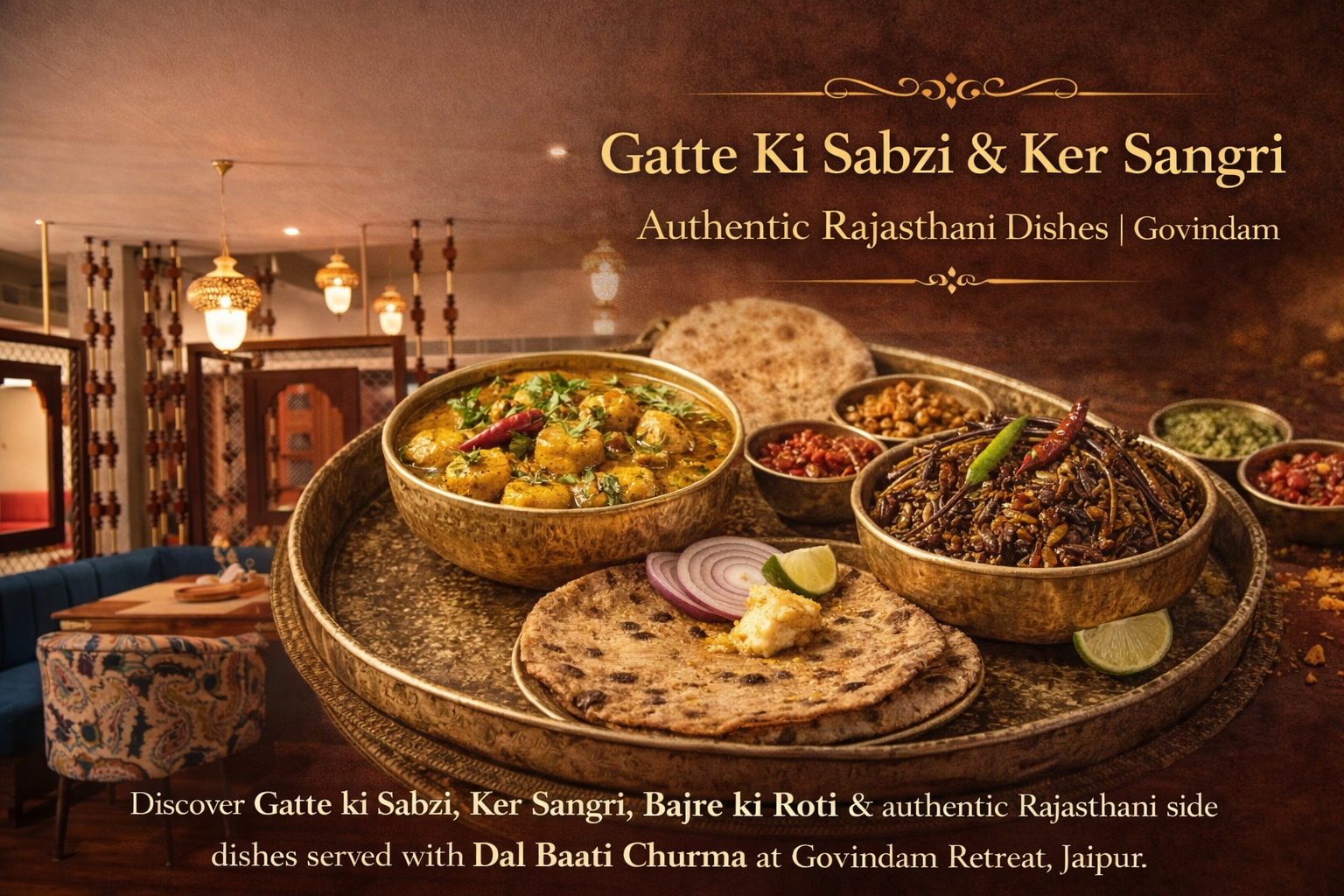
Gatte Ki Sabzi & Ker Sangri — Authentic Rajasthani Dishes | Govindam
14 March 2026
Gatte Ki Sabzi & Ker Sangri — Authentic Rajasthani Dishes | Govindam
Gatte ki sabzi, ker sangri, bajre ki roti, lahsun chutney, and seasonal sabzi complete every authentic Rajasthani thali at Govindam Retreat in Jaipur. As a dedicated gatte ki sabzi ker sangri Jaipur restaurant, Govindam Retreat serves all ten classic regional preparations alongside dal baati churma — prepared fresh daily near City Palace. Gatte ki sabzi […]
GR
Govindam Retreat Editorial TeamReviewed for Jaipur food lovers and tourists
Gatte ki sabzi, ker sangri, bajre ki roti, lahsun chutney, and seasonal sabzi complete every authentic Rajasthani thali at Govindam Retreat in Jaipur. As a dedicated gatte ki sabzi ker sangri Jaipur restaurant, Govindam Retreat serves all ten classic regional preparations alongside dal baati churma — prepared fresh daily near City Palace.
Gatte ki sabzi and ker sangri are the two dishes most visitors at a gatte ki sabzi ker sangri Jaipur restaurant encounter for the first time on a traditional thali and immediately ask about. Both are deeply regional in origin, both are made from ingredients with no equivalent in standard North Indian restaurant cooking, and both are the dishes that — once eaten in the right context alongside dal baati churma — define what a Rajasthani thali actually is at its most complete and most traditional.
Govindam Retreat near Govind Dev Ji Temple in Jaipur’s Pink City is a gatte ki sabzi ker sangri Jaipur restaurant that serves both preparations alongside eight other traditional Rajasthani dishes as part of the Traditional Rajasthani Thali (Dal Bati Churma). This page covers every dish on the thali — what each one is, where it comes from, what it tastes like, and why it belongs on the same plate as the dal baati churma that anchors the meal.
Gatte ki sabzi and ker sangri are the two regional preparations visitors search for most frequently before a Jaipur visit — and understanding what they are before they arrive at the table makes the eating significantly more meaningful.
10 Rajasthani Dishes Served at Govindam Retreat
Gatte Ki Sabzi
Gatte ki sabzi is a signature Rajasthani preparation made from gram flour (besan) mixed with spices, kneaded into a firm dough, rolled into cylinders, and boiled in water until fully set. The cooked cylinders — called gatte — are sliced into rounds and returned to a gravy made from sour curd tempered with mustard seeds, cumin, dried red chilli, and asafoetida in pure desi ghee. The result is a sabzi that is simultaneously tangy, slightly spiced, and rich from the ghee tempering.
What distinguishes gatte ki sabzi from any other Indian curd-based curry is the gram flour base. The gatte hold their shape in the gravy rather than dissolving — each round carries a firm, dense interior that absorbs the curd flavour from the outside while retaining its own texture at the centre. In the context of a full Rajasthani thali at Govindam Retreat, is served alongside the baati so guests can alternate between the rich panchmel dal pour and the lighter, tangier curd-based preparation. For visitors specifically looking for a , the combination of both dishes in a single thali sitting is what makes the Royal Rajasthani Thali here the recommended choice.
Ker sangri is perhaps the most distinctly Rajasthani preparation in the entire regional food canon. Ker is a small wild desert berry from the shrub Capparis decidua{:rel=”noopener” target=”_blank”} — a thorny plant native to the Thar Desert that produces small, tart green berries used as both food and traditional medicine across the desert communities of western Rajasthan. Sangri is the dried bean pod of the Prosopis cineraria{:rel=”noopener” target=”_blank”} (Khejri tree) — the official state tree of Rajasthan, which is so deeply integrated into the desert ecosystem and the agricultural life of the region that it is considered sacred in many Rajasthani communities.
Both ker and sangri are dried and rehydrated overnight before cooking. They are prepared together in a dry sabzi format using mustard oil, whole dried spices, raw mango powder (amchur), and red chilli. The flavour of ker sangri is sour, slightly bitter at the edges from the ker berry, and deeply savoury from the spice base and the sangri. No equivalent preparation exists in any other Indian regional cuisine, and the ingredient availability is naturally limited to Rajasthan and neighbouring desert areas where both plants grow. At Govindam Retreat, ker sangri is sourced from the Thar region in its dried form and rehydrated in the kitchen before each preparation batch. It is served as a dry sabzi accompanying the thali and is the dish that most reliably prompts guests to stop mid-bite and ask what they are eating. The combination of gatte ki sabzi and ker sangri together on one thali represents Rajasthani cuisine at its most regionally specific — and both are available at this gatte ki sabzi ker sangri Jaipur restaurant.
Bajre Ki Roti
Bajra is pearl millet — the primary grain of the Rajasthani desert diet for centuries, grown in arid soil where wheat cannot survive. Bajre ki roti is a thick, dense flatbread made from pearl millet flour, cooked on a tawa without oil, and finished with pure desi ghee applied generously before it reaches the table. The texture is coarser and denser than a wheat roti, and the flavour is nutty and slightly earthy. It pairs naturally with gatte ki sabzi and ker sangri — the grain and the sabzi are calibrated for each other by centuries of regional cooking rather than by recipe design. Guests eating bajre ki roti at Govindam Retreat are eating the same grain-sabzi combination that Rajasthani households have served at the same table for generations.
Lahsun Chutney
Rajasthani lahsun chutney is not the mild garlic chutney found in other regional kitchens. It is a preparation of dried red chillies, fresh garlic, salt, and occasionally dried mango powder ground together into a thick, intensely flavoured paste. The heat level is substantial and the garlic flavour is raw and direct. At Govindam Retreat, lahsun chutney is hand-ground daily in small batches and served as a condiment that guests use to adjust the heat of each component — particularly the bajre ki roti and the ker sangri, where the chutney heat and the berry sourness create a distinctive combination specific to Rajasthani desert food culture.
Missi Roti
Missi roti is a mixed-flour flatbread combining wheat flour and gram flour with fenugreek leaves, ajwain seeds, and turmeric. The gram flour content gives it a denser texture than a plain wheat roti, and the fenugreek adds mild bitterness that ajwain rounds out. It is cooked on a tawa without oil and finished with pure desi ghee. At Govindam Retreat, missi roti appears on the thali as the second bread option alongside bajre ki roti, giving guests a direct comparison of the two primary traditional flatbreads of Rajasthan in one sitting.
Boondi Raita
Boondi raita is fresh curd into which small fried gram flour droplets called boondi are stirred just before serving, along with roasted cumin powder, black salt, and finely chopped green chilli and coriander. The boondi softens into the curd over a short period, creating a texture that contrasts the firmer elements of the thali. In the context of a full Rajasthani meal with gatte ki sabzi and ker sangri on the plate, the raita functions as the cooling element — the curd base lowers the perceived heat of the lahsun chutney and the panchmel dal tempering, giving the palate a reset between more intensely spiced components.
Moong Halwa
Moong halwa is a traditional Rajasthani sweet made from skinned split green lentils slow-cooked in pure desi ghee until golden, then combined with sugar, cardamom, and garnished with cashews, almonds, and saffron strands. The preparation requires continuous stirring over a slow flame for 30 to 45 minutes — the time and ghee investment shows in the depth of flavour and the grainy-soft texture. It is served as the warm sweet course on the Royal Rajasthani Thali at Govindam Retreat on selected days.
Gulab Jamun
Gulab jamun at Govindam Retreat is made from mawa (reduced milk solids) and a small proportion of flour, shaped into smooth rounds, fried in pure desi ghee until deep golden, and soaked in rose-scented sugar syrup with cardamom and saffron. Frying in pure desi ghee rather than refined oil changes the flavour profile entirely — the ghee adds a richness to the fried surface that oil cannot produce. These are served warm on the Royal Thali as the closing sweet course.
Papad — Three Varieties
Govindam Retreat serves three papad varieties with the full thali: plain roasted urad dal papad, masala papad topped with finely chopped onion, tomato, green chilli, and coriander dressed with lemon, and moong dal papad which is thinner and crisper than the urad variety. All three are roasted, not fried. The three flavour and texture profiles give guests crunchy, light accompaniments that work as palate-clearing elements between the heavier components — particularly between the gatte ki sabzi curd gravy and the ker sangri dry preparation.
Seasonal Sabzi
The seasonal sabzi at Govindam Retreat changes with daily market sourcing from Jaipur’s local mandis. Common preparations include aloo methi (potato and fenugreek), lauki ki sabzi (bottle gourd), and pyaaz ki kachri (wild onion desert preparation specific to the Thar region). The daily variation reflects how Rajasthani household cooking actually works — not from a fixed menu card but from what the season and the market make available. According to the Rajasthan Tourism official resource on regional cuisine{:rel=”noopener” target=”_blank”}, seasonal and desert-foraged ingredients have always been central to the Rajasthani food tradition, and this philosophy is directly reflected in the changing seasonal sabzi at Govindam Retreat.
Our Full Thali — What Is on the Plate
The Traditional Rajasthani Thali at Govindam Retreat is assembled from the dishes above in combinations that vary by thali type. As a gatte ki sabzi ker sangri Jaipur restaurant, Govindam Retreat offers both preparations as part of the Royal Rajasthani Thali — the widest range of regional dishes in a single sitting.
Thali
Included Dishes
Price
Standard Dal Baati Churma Thali
4 baatis, panchmel dal, moong dal, both churma options, lahsun chutney, coriander-mint chutney, masala papad, seasonal sabzi, chaas
Rs. 349 per person
Royal Rajasthani Thali
6 baatis, three dal varieties, both churma, gatte ki sabzi or ker sangri (seasonal), bajre ki roti, missi roti, boondi raita, three papad varieties, lahsun chutney, moong halwa or gulab jamun, extra ghee katori
Rs. 499 per person
Dal Baati Churma for Two
Standard thali set for two with shared accompaniments
Rs. 700 for two
Availability of gatte ki sabzi, ker sangri, moong halwa, and bajre ki roti varies by day and season. Each dish is prepared from scratch each morning based on daily market sourcing. To confirm that both gatte ki sabzi and ker sangri are on the preparation schedule for your specific visit, contact the kitchen at +91-7976304072 the day before or on the morning of your visit.
For group visits and private celebrations, the Chef’s Special Ring Ceremony package and the Street Food Party Menu include custom selection of Rajasthani dishes beyond the standard thali format. Corporate groups visiting via the Corporate Tea Break Menu can request traditional Rajasthani snack components including gatte ki sabzi and ker sangri based preparation items to supplement the standard format. For a dal bati churma restaurant in Jaipur experience that includes the full regional dish range, Govindam Retreat is the recommended choice nearest to City Palace.
Book Your Thali Experience
Govindam Retreat serves the full gatte ki sabzi ker sangri Rajasthani thali every day from 10:00 AM to 9:30 PM. Walk-ins are welcome at all hours. For groups of four or more, advance reservation is recommended to ensure the widest selection of seasonal dishes — including gatte ki sabzi and ker sangri — is available and confirmed before your arrival.
Name: Govindam Retreat Address: Near Govind Dev Ji Temple, Gangori Bazaar, J.D.A. Market, Pink City, Jaipur, Rajasthan — 302003 Phone and WhatsApp: +91-7976304072 Email: info@govindam.co.in Website: govindamretreat.in Hours: 10:00 AM to 9:30 PM daily
How This Page Was Researched and Verified
This content was developed with the Govindam Retreat kitchen team, with dish descriptions verified against preparation methods observed on-site and cross-referenced with Rajasthani culinary tradition references. Seasonal dish availability confirmed with the kitchen team in March 2026. Pricing confirmed directly with the restaurant team.
[Author Name] — Jaipur Food Heritage Writer, 10+ years Rajasthani culinary research. View full author profile at [/author/author-name/]. Last reviewed and verified: March 2026.
Disclaimer: Seasonal dish availability varies daily based on market sourcing — confirm gatte ki sabzi and ker sangri availability at +91-7976304072 on your visit date. Prices are indicative and subject to revision. Guests with dietary requirements, allergies, or medical conditions should inform the kitchen team at the time of booking. FSSAI licence number available on request at the establishment.
FAQs — Word Count Displayed Separately from Main Article
What Is Gatte Ki Sabzi and How Is It Prepared at a Jaipur Restaurant?
Gatte ki sabzi is a Rajasthani curry made from steamed gram flour dumplings sliced and returned to a tangy curd-based gravy tempered with mustard seeds, cumin, and dried red chilli in pure desi ghee. At Govindam Retreat, a dedicated gatte ki sabzi ker sangri Jaipur restaurant, the preparation is made fresh daily and served as part of the Royal Rajasthani Thali.
What Is Ker Sangri and Why Is It Unique to Rajasthani Cuisine?
Ker sangri is a dry preparation combining ker berries (Capparis decidua) and sangri bean pods (Prosopis cineraria) — both native to the Thar Desert. The dried ingredients are rehydrated overnight and cooked in mustard oil with whole spices and raw mango powder. No equivalent preparation exists in any other Indian regional cuisine. At Govindam Retreat, ker sangri is sourced from the Thar region in its traditional dried form.
Can I Get Both Gatte Ki Sabzi and Ker Sangri in One Sitting at Govindam Retreat?
Yes — both gatte ki sabzi and ker sangri are available together as part of the Royal Rajasthani Thali at Rs. 499 per person. Availability is seasonal and batch-prepared. To confirm that both dishes are on the schedule for your specific visit date, contact the kitchen at +91-7976304072 the day before or on the morning of your visit.
What Makes Gatte Ki Sabzi Different from Other Indian Curd-Based Curries?
What distinguishes gatte ki sabzi is the gram flour base of the dumplings. The gatte hold their firm, dense shape in the curd gravy rather than dissolving into it — each round carries its own texture against the tangy liquid. This structural quality is specific to the gram flour preparation method and is not found in curd-based curries from other Indian regional traditions.
Is Ker Sangri Available Year-Round at Govindam Retreat?
Ker sangri is a dried desert ingredient and is available beyond the fresh growing season, but kitchen preparation batches vary by day. As a gatte ki sabzi ker sangri Jaipur restaurant, Govindam Retreat sources dried ker and sangri from the Thar region — availability at the restaurant depends on preparation scheduling. Confirm at +91-7976304072 before your visit to avoid disappointment.
What Does Ker Sangri Taste Like for First-Time Diners?
Ker sangri has a flavour profile unlike any other Indian dish — the ker berries bring sourness and slight bitterness at the edges, while the sangri adds an earthy, nutty base. The mustard oil, raw mango powder, and whole spice tempering create a deeply savoury dry preparation that is intensely regional in character. Most first-time guests describe it as surprising, immediately interesting, and unlike anything they expected from an Indian vegetable preparation.
Which Thali at Govindam Retreat Includes Gatte Ki Sabzi and Ker Sangri Together?
The Royal Rajasthani Thali at Rs. 499 per person includes both gatte ki sabzi and ker sangri (subject to seasonal availability) alongside 6 baatis, three dal varieties, both churma options, bajre ki roti, missi roti, boondi raita, three papad varieties, and a closing sweet. It is the recommended thali for guests who want to experience the full range of Rajasthani regional cuisine at a gatte ki sabzi ker sangri Jaipur restaurant.
What Is Bajre Ki Roti and Why Does It Pair Well with Gatte Ki Sabzi?
Bajre ki roti is made from pearl millet flour — coarser, denser, and more nutritionally robust than wheat roti. It is cooked without oil on a tawa and finished with pure desi ghee. The earthy, nutty flavour of bajra pairs naturally with the tangy curd gravy of gatte ki sabzi — the two were eaten together in Rajasthani households long before restaurant versions of either dish existed.
Is Govindam Retreat Suitable for Guests Trying Gatte Ki Sabzi and Ker Sangri for the First Time?
Yes — the kitchen team introduces unfamiliar dishes to first-time guests on request, explaining the ingredients and the preparation method for both gatte ki sabzi and ker sangri before the meal begins. The thali format makes exploration easy — all dishes arrive together and guests can try each at their own pace without committing to individual dish orders.
How Does Gatte Ki Sabzi Compare to Palak Paneer or Other North Indian Curries?
Gatte ki sabzi and palak paneer are structurally different dishes. Palak paneer is a fresh green leaf and fresh cheese curry with a smooth gravy base. Gatte ki sabzi is a gram flour dumpling in a soured curd-based gravy — the base is fermented and tangy rather than fresh and green, and the dumplings are cooked dough rather than cheese. The flavour, texture, and cultural origin of gatte ki sabzi are entirely specific to Rajasthani desert cuisine and share no preparation logic with North Indian standard menu curries.
Can I Order Gatte Ki Sabzi and Ker Sangri as a Takeaway from Govindam Retreat?
Both gatte ki sabzi and ker sangri are available as part of a full Royal Rajasthani Thali takeaway order. Advance notice is required as both are batch-prepared dishes — not permanently available on immediate demand. Contact the kitchen at +91-7976304072 the day before to arrange a takeaway order that includes both preparations alongside the dal baati churma thali components.
Is Govindam Retreat the Best Gatte Ki Sabzi Ker Sangri Jaipur Restaurant Near City Palace?
Govindam Retreat is 400 metres from City Palace in Gangori Bazaar — the most historically relevant food district in Jaipur’s Pink City. As a strictly pure vegetarian establishment with 11,442 JustDial guest ratings, a clay chulha dal baati churma preparation, and a Royal Rajasthani Thali that includes both gatte ki sabzi and ker sangri, it is the most accessible and most reviewed traditional Rajasthani thali restaurant in the immediate City Palace area.
Book Table
Reserve Your Royal Vegetarian Dining Experience
Planning lunch, dinner, a family meal, tourist group visit, corporate lunch, or celebration near Govind Dev Ji Temple? Book your table at Govindam Retreat.