A complete Jaipur food tour covers nine essential stops — from pyaaz kachori at Rawat near Sindhi Camp to lassi at Lassiwala on MI Road, ghewar in Johri Bazaar, and authentic dal baati churma at Govindam Retreat near Govind Dev Ji Temple. Open 11 AM to 11 PM. Book at govindamretreat.in.
The Jaipur Food Tour That Goes Beyond the Tourist Trail
Every Jaipur food tour starts at Hawa Mahal and ends with a lassi. That is the standard version — pleasant, well-photographed, and covering approximately 30 percent of what Jaipur’s food culture actually contains. A complete Jaipur food tour covers the street food circuit through the walled city, the heritage sweet shops in Johri Bazaar, the chai culture of the inner-city lanes, and the full sit-down Rajasthani thali experience that ties the day together. This guide covers all nine stops — where to go, what to eat, what each preparation represents in the Rajasthani culinary tradition, and how to build the day so the food makes sense as a sequence rather than a random series of eating stops. Govindam Retreat anchors the Jaipur food tour as the sit-down meal that converts a food walk into a cultural education.
Quick Answers — Jaipur Food Tour 2026
| Question | Answer |
|---|---|
| What is the best starting point for a Jaipur food tour? | Hawa Mahal area in the morning — pyaaz kachori at Rawat, followed by chaat in Johri Bazaar |
| How long does a complete Jaipur food tour take? | 4 to 6 hours for the full 9-stop circuit — best started at 9 AM for a morning-to-afternoon tour |
| What is the best sit-down meal stop on a Jaipur food tour? | Govindam Retreat — 16-item Rajasthani thali ₹600 plus GST, 7,443 reviews, 0.4 km from Govind Dev Ji Temple |
| Is a Jaipur food tour suitable for strict vegetarians? | Yes — Jaipur’s food culture is predominantly vegetarian; Govindam Retreat’s sattvic kitchen covers all dietary standards |
| What time does the restaurant stop on the Jaipur food tour open? | 11:00 AM to 11:00 PM — the lunch session is the best timing for the thali stop |
| How much does the complete Jaipur food tour cost? | Street food stops ₹500–₹1,000 total; Govindam Retreat thali ₹600 plus GST |
Table of Contents
- The Jaipur Food Tour That Goes Beyond the Tourist Trail
- Stop 1 — Pyaaz Kachori at Rawat Misthan Bhandar
- Stop 2 — Mirchi Bada and Samosa at the Walled City Stalls
- Stop 3 — Jaipuri Chaat at Johri Bazaar
- Stop 4 — Ghewar and Mithai at the Heritage Sweet Shops
- Stop 5 — Masala Chai at the Inner-City Tea Stalls
- Stop 6 — Kulfi and Rabri at Lassiwala on MI Road
- Stop 7 — Govindam Retreat — the Jaipur Food Tour Thali Stop
- Stop 8 — Dal Baati Churma — Why This Dish Anchors the Day
- Stop 9 — Post-Meal Paan and the Close of the Jaipur Food Tour
Stop 1 — Pyaaz Kachori at Rawat Misthan Bhandar
No Jaipur food tour begins without a pyaaz kachori. The pyaaz kachori — a deep-fried pastry shell filled with spiced onion and potato — is Jaipur’s signature morning street food. Rawat Misthan Bhandar near Sindhi Camp is the benchmark. The kachoris come out of the oil in batches through the morning, and the crowd at the counter from 7 AM onwards tells you everything about the reputation of the preparation.
A pyaaz kachori costs ₹15 to ₹25 depending on size. It is served with a green chutney and a sweet tamarind dip. Eat it immediately — kachoris degrade quickly and the crunch that defines them is at its peak in the first three minutes. The filling should be moist and deeply spiced without being wet. The pastry should shatter when you press it. At Rawat, it does both. This is the correct first stop on any Jaipur food tour, and it sets the expectation for what Jaipur street food produces when it is done properly.
Stop 2 — Mirchi Bada and Samosa at the Walled City Stalls
The mirchi bada is specifically Rajasthani — a large green chilli stuffed with a spiced potato mixture, coated in besan batter and deep fried. The heat level varies by the chilli and the day, which is part of the experience. Pair it with a samosa from the same stall. In the walled city near Badi Chaupar, stalls that have been operating for decades serve mirchi bada and samosa from early morning through the afternoon.
These are ₹10 to ₹20 snacks eaten standing at the counter. No seating, no menu, no wait for the order to be processed. The preparation is visible — you watch the chilli go into the batter and come out of the oil. That transparency is part of the Jaipur food tour experience: the street food is cooked in front of you, and the freshness of the preparation is directly observable. Include this stop on your Jaipur food tour before the sweet section, while your palate is still calibrated for savoury.
Stop 3 — Jaipuri Chaat at Johri Bazaar
Johri Bazaar is the jewellery quarter of Jaipur’s walled city — lined with silver and gemstone shops that have been operating since the Maharajas were their primary customers. It is also the street food corridor where chaat vendors set up through the day. A Jaipur food tour that skips Johri Bazaar misses the most photogenic and most flavour-intense stretch of the food walk.
Dahi bhalle — lentil dumplings soaked in seasoned yoghurt and topped with tamarind chutney, green chutney, and a chilli powder finish — is the essential Johri Bazaar stop. Bhel puri and pani puri (golgappa) are available from the same stalls. The combination of sweet, sour, and spicy in the same bite is the definition of Jaipuri chaat, and experiencing it in the middle of Johri Bazaar — surrounded by the noise and colour of the jewellery market — gives the Jaipur food tour its most sensory moment.
Stop 4 — Ghewar and Mithai at the Heritage Sweet Shops
Ghewar is the Jaipur sweet that appears on every Jaipur food tour and cannot appear on any food tour that is not in Jaipur. The technique for making ghewar — pouring batter in a circular pattern into hot ghee, producing a porous disc that is soaked in sugar syrup and topped with rabri, saffron, or chopped nuts — requires a specific temperature, rhythm, and understanding of how the disc builds. No equivalent preparation exists in any other Indian regional tradition.
LMB (Laxmi Misthan Bhandar) in Johri Bazaar has been making ghewar since 1727 and is the heritage reference point. The sweet shops on the surrounding streets offer comparable quality at street prices. Include at least one ghewar on your Jaipur food tour — not as an afterthought sweet at the end of the day, but as a dedicated stop where you watch the preparation and eat it fresh. A fresh ghewar is categorically different from one that has been sitting for six hours.
Rajasthani mithai — including mawa kachori, gujiya, and balushahi — rounds out the sweet section of the Jaipur food tour. Each has a specific festival association and a specific technique. Understanding what you are eating enriches the experience beyond just noting that it is sweet and satisfying.
Stop 5 — Masala Chai at the Inner-City Tea Stalls
A Jaipur food tour runs on chai. The correct chai for this food walk is not the hotel room service version and not the café chain interpretation. It is the inner-city stall chai — strong, spiced, made with full-fat milk, poured through a strainer into a small glass or clay cup, served at a temperature that requires you to hold the glass by the rim. ₹10 to ₹15 per glass. Bottomless conversation with the stall owner, who has been making chai at the same corner since before the current road surface was laid.
Sahu Chai Wala, which famously served the Prime Minister and the President of France in the same month, is the most celebrated chai stop on the Jaipur food tour circuit. The standard inner-city tea stalls adjacent to the heritage mosques near Badi Chaupar offer the same quality with less foot traffic. For a complete Jaipur food tour, two chai stops — one mid-morning and one after the thali lunch — maintain the energy and the cultural register through the full day.
Stop 6 — Kulfi and Rabri at Lassiwala on MI Road
The Lassiwala on MI Road is one of the most iconic addresses on any Jaipur food tour. The lassi here is thick, full-fat, cold, and made with the kind of deliberate slowness that signals the product is more important than the throughput. The shop has been operating since 1944. It opens in the morning and closes when the lassi for the day is finished. Arriving after 2 PM on a busy day risks finding the shutters down.
The lassi comes in two versions — sweet and salted. The sweet version is served in earthenware pots (kulhad) or in a stainless steel glass. The earthenware version absorbs some of the moisture and changes the flavour slightly — slightly earthier, slightly less sharp. Both versions are correct. Include Lassiwala as the bridge between the street food morning section and the thali lunch section of your Jaipur food tour — the lassi settles the stomach and prepares it for the main meal.
Stop 7 — Govindam Retreat — the Jaipur Food Tour Thali Stop
Every Jaipur food tour needs an anchor meal. Street food is extraordinary in Jaipur — varied, deeply flavoured, and representative of the culinary tradition at a street level. But the sit-down thali at a heritage restaurant near Govind Dev Ji Temple provides something that no kachori stall or chaat vendor can: the complete expression of Rajasthani cuisine in one spread, with cultural context, table service, live folk music, and the time to appreciate what you are eating rather than consuming it standing at a counter.
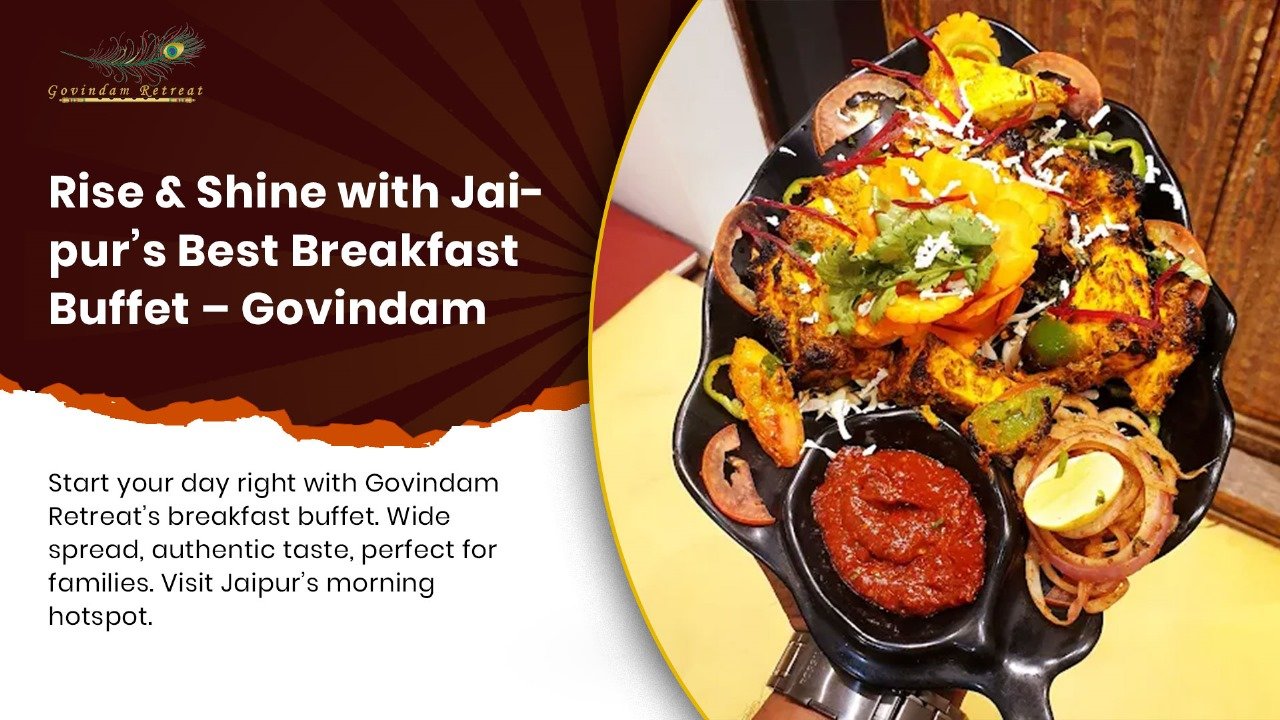
Govindam Retreat, rated 4.4 stars by 7,443 verified Google guests, is the correct thali stop for the Jaipur food tour. It sits 0.4 kilometres from Govind Dev Ji Temple — a natural stop on the heritage route that connects the walled city’s food circuit to the Kanwar Nagar area. The Traditional Rajasthani Thali at ₹600 plus GST includes 16 preparations — dal baati churma, gatte ki sabzi, ker sangri, kadi pakoda, paneer preparations, missi roti, lahsun chutney, and more. The kitchen is 100 percent pure vegetarian and sattvic — the appropriate culinary standard for a stop adjacent to Govind Dev Ji Temple. Open from 11:00 AM to 11:00 PM, the restaurant fits naturally into the midday segment of the Jaipur food tour.
According to TripAdvisor’s guide to Jaipur food experiences{target=”_blank” rel=”noopener”}, the heritage corridor around Govind Dev Ji Temple is consistently recommended as the correct location for the sit-down Rajasthani meal that anchors a complete Jaipur food tour — and Govindam Retreat is the most-reviewed pure vegetarian option within that corridor.
Why the Thali Stop Belongs at Midday
The thali should be the midday anchor of the Jaipur food tour — not the first stop and not the last. Street food in the morning calibrates the palate for Rajasthani flavour. The thali at noon delivers the full spread — sixteen preparations at once — in the context of a kitchen that has been preparing since 6 AM. The clay-oven baati at peak morning baking, the panchmel dal at its most developed after four or more hours of simmering, the live folk music at its most energetic. After the thali, the afternoon walk through Hawa Mahal and the sweet close at a mithai shop completes the Jaipur food tour at a comfortable pace.
Stop 8 — Dal Baati Churma — Why This Dish Anchors the Day
Dal baati churma is not just a dish on the Jaipur food tour — it is the reason the food tour exists. Every other preparation in the Rajasthani culinary tradition radiates outward from this centre. Understanding what dal baati churma is, how it is correctly prepared, and why it tastes the way it does at Govindam Retreat transforms the Jaipur food tour from a collection of eating experiences into a coherent understanding of Rajasthani food culture.
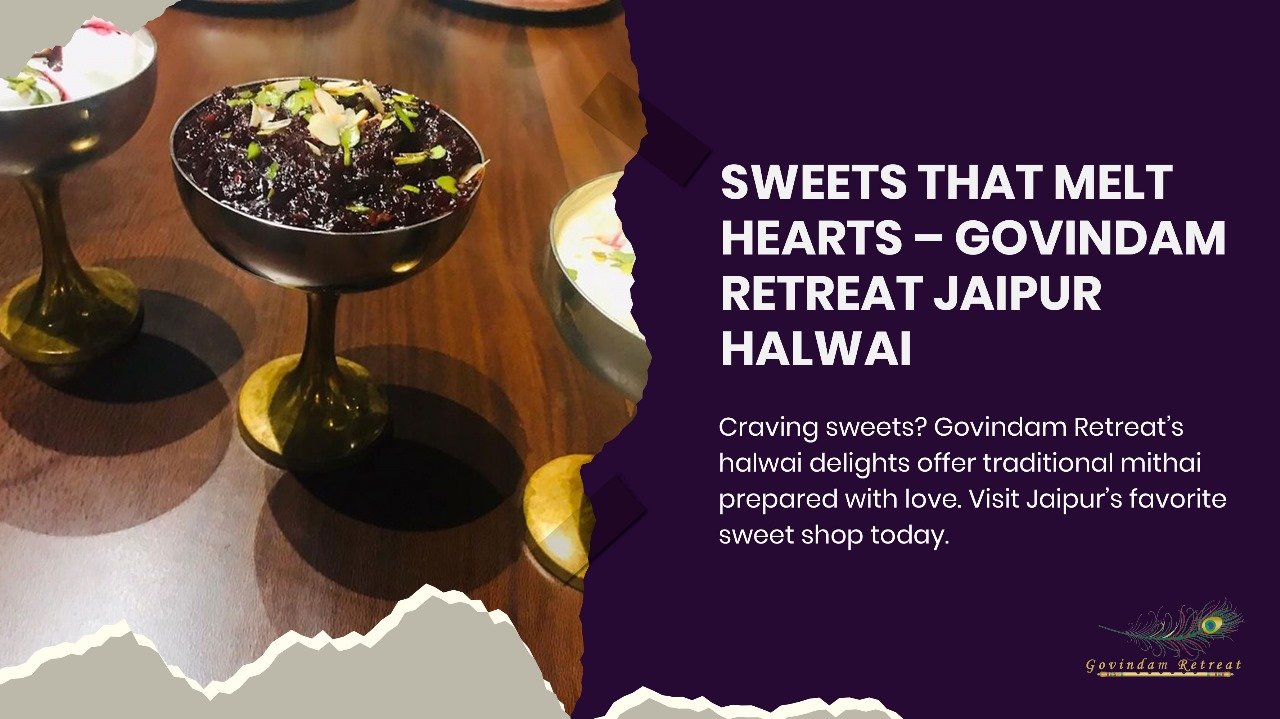
The baati bakes in a clay oven. The panchmel dal simmers from morning. The churma is sweetened with jaggery. Crack the baati open. Pour ghee into the cavity. Pour dal over it. Take a bite with churma alongside. This sequence — the crack, the ghee, the dal pour — is the Rajasthani eating ritual that has been unchanged for centuries, and experiencing it correctly at Govindam Retreat is the most culturally significant eating moment on the Jaipur food tour.
The complete guide to dal baati churma in Jaipur covers every aspect of the preparation for guests who want to understand the dish before the Jaipur food tour begins.
Stop 9 — Post-Meal Paan and the Close of the Jaipur Food Tour
The traditional close of any Rajasthani meal is paan — betel leaf folded around a filling of areca nut, lime paste, fennel seeds, and condiments according to preference. In the lanes around Govind Dev Ji Temple and Johri Bazaar, paan shops operate from mid-morning through late evening, and the paan wala at each shop is as much a craftsman as the kachori fryer or the lassi maker.
A Jaipur food tour that ends with paan — after the thali, after the mithai, after the chai — ends correctly. The cooling, aromatic quality of a sweet paan after a rich Rajasthani meal is the palate reset that the tradition built in. It is not a tourist addition to the food walk. It is part of the sequence, and the Jaipur food tour that includes it closes as a complete cultural experience rather than as a collection of photographs.
According to Incredible India’s Jaipur food culture guide{target=”_blank” rel=”noopener”}, the Jaipur food tour circuit through the walled city — kachori in the morning, chaat at Johri Bazaar, thali at the heritage zone near Govind Dev Ji Temple, mithai at the heritage sweet shops, and paan as the close — is the most culturally complete food day available in any single Indian city.
Practical Planning for Your Jaipur Food Tour
Recommended Jaipur Food Tour Schedule
| Time | Stop | What to Eat | Cost |
|---|---|---|---|
| 9:00–9:30 AM | Rawat Kachori, Sindhi Camp | Pyaaz kachori, chai | ₹50–₹80 |
| 9:30–10:30 AM | Walled city stalls, Badi Chaupar | Mirchi bada, samosa, chaat | ₹80–₹150 |
| 10:30–11:15 AM | Johri Bazaar | Jaipuri chaat, dahi bhalle | ₹80–₹120 |
| 11:15 AM–11:45 AM | LMB and heritage sweet shops | Ghewar, mawa kachori | ₹100–₹200 |
| 11:45 AM–12:15 PM | Lassiwala, MI Road | Lassi in kulhad | ₹60–₹100 |
| 12:30–2:00 PM | Govindam Retreat thali stop | 16-item Rajasthani thali | ₹600 + GST |
| 2:00–3:30 PM | City Palace, Hawa Mahal walk | Afternoon heritage exploration | — |
| 3:30–4:00 PM | Mithai shops, Johri Bazaar | Afternoon sweet pick | ₹80–₹150 |
| 4:00 PM | Paan at inner-city paan shop | Post-tour traditional close | ₹20–₹50 |
Tips for the Best Jaipur Food Tour
| Tip | Why It Matters |
|---|---|
| Start before 9:30 AM for kachori | Rawat’s kachoris peak at morning freshness — later in the day the quality drops |
| Book Govindam Retreat in advance | Call 9929949258 before the Jaipur food tour morning — sessions fill on weekends |
| Eat light at street stops | The thali is the main meal — pace yourself through the morning stops |
| Carry water throughout | Jaipur food tour walking is dehydrating — street food is spiced and salty |
| Visit Lassiwala before 2 PM | The shop closes when daily lassi runs out — early visits guaranteed |
Govindam Retreat | Near Govind Dev Ji Temple | Kanwar Nagar | Jaipur, Rajasthan 302002 | 9929949258 | razzasha007@gmail.com | govindamretreat.in | Open 11:00 AM to 11:00 PM — All Days
Book the Jaipur food tour thali stop now | View the thali menu | Explore all packages
Frequently Asked Questions — Jaipur Food Tour
What is the correct order of stops on a Jaipur food tour?
The correct sequence for a food walk through Jaipur begins with morning street food — pyaaz kachori at Rawat, walled city chaat, Johri Bazaar dahi bhalle — followed by the sit-down Rajasthani thali at Govindam Retreat near Govind Dev Ji Temple at midday, afternoon heritage walking, mithai at LMB or heritage sweet shops, and paan as the traditional close. This sequence builds the flavour narrative from snack to full meal to sweet without overloading the palate at any single point.
How much does a complete Jaipur food tour cost per person?
Street food across eight morning and afternoon stops on a standard culinary walk costs approximately ₹450 to ₹800 per person depending on portion sizes chosen. The Govindam Retreat thali stop adds ₹600 plus GST per person. A complete Jaipur food tour costs approximately ₹1,050 to ₹1,400 per person including the full sit-down meal — less than most hotel buffets and more culturally comprehensive than any alternative.
Can I do a Jaipur food tour as a strict vegetarian or Jain guest?
Yes — Jaipur’s food culture is predominantly vegetarian by tradition. Almost all street food stops on the Jaipur food tour circuit are pure vegetarian. Govindam Retreat operates a pure vegetarian sattvic kitchen with no onion or garlic in traditional preparations — appropriate for both Vaishnav vegetarians and Jain guests with advance customisation. The Jaipur food tour is one of the most accessible food walks in India for strict vegetarians.
Is a guided food tour better than a self-guided Jaipur food tour?
Both approaches work. A guided food walk provides local knowledge about specific stalls, historical context for each preparation, and navigation through the walled city lanes that first-time visitors find confusing. A self-guided tour using this guide is cheaper and more flexible. For the Govindam Retreat thali stop, self-booking is straightforward — call 9929949258 or email razzasha007@gmail.com with your date and group size.
What is the best season for a Jaipur food tour?
October through February is the best season for a Jaipur food tour — cooler temperatures make the walking sections comfortable, the heritage sites are accessible without the summer heat, and seasonal preparations like the Navratri vrat menu and winter mithai varieties add depth to the food experience. This food walk is possible year-round, but the October-to-February window delivers the most complete experience.
Can I include Govindam Retreat as the anchor restaurant on my Jaipur food tour?
Yes — Govindam Retreat is specifically positioned as the sit-down thali anchor on the Jaipur food tour route. At 0.4 km from Govind Dev Ji Temple and 0.8 km from City Palace, it sits at the natural midday point on the heritage food circuit. Booking in advance at 9929949258 is recommended for the Jaipur food tour thali stop — particularly for groups of 10 or more and for weekend visits.
How long should I allocate for the Govindam Retreat thali stop on the Jaipur food tour?
Allocate 90 minutes for the Govindam Retreat thali stop on your food walk — 60 minutes for the thali meal with three or four refill rounds and live folk music, and 30 minutes for the cultural experience of the heritage dining hall and conversation with the staff about the specific dishes. For groups under time pressure, the express 60-minute session can be confirmed at booking.
Is the Jaipur food tour suitable for children?
Yes — food touring in Jaipur is highly suitable for children. The kachori and lassi stops are universally popular with younger guests. The Govindam Retreat thali includes multiple mild preparations — jeera rice, paneer dishes, plain roti, churma sweet — that children eat comfortably alongside the more robust Rajasthani preparations for adults. The live folk music at Govindam Retreat holds children’s attention through the full thali session.
The Jaipur Food Tour That Earns the City’s Culinary Reputation
A food day in Jaipur done correctly is one of the best single-day food experiences in India. Nine stops, five hours, one complete cultural education in Rajasthani cuisine — from the first kachori to the last paan. Govindam Retreat anchors the day as the sit-down thali stop where the food walk becomes a cultural education: 16 dishes, clay-oven baati, panchmel dal from morning, jaggery churma, live folk music, and 7,443 guests at 4.4 stars confirming the standard. Book the thali stop at govindamretreat.in or call 9929949258 before your food walk morning.
Govindam Retreat | Near Govind Dev Ji Temple | Kanwar Nagar | Jaipur, Rajasthan 302002 | 9929949258 | razzasha007@gmail.com | govindamretreat.in | Open 11 AM to 11 PM — All Days